I grew up on Alan Grant comics, but I knew the Alan Grant atmsophere, the Alan Grant experience before I recognized (and learned to look for) the name. I remember thinking “These Batman comics really read like Judge Dredd,” and there in the credits was Grant's name. Lobo? I was annoyed with what Lobo seemed to be in ads, in talk from others, but when I read Lobo stuff, it was hilarious. I began to associate the name with being metal funny, anarchically funny, but very sound and compassionate in an honest way.
Travis Hedge Coke: “You've worked on comics for a number of companies over your career, which presumably have different levels comfort about content. Do you deliberately tailor your work to the kind of publisher or the perceived market? Or, does it happen more naturally?”
Alan Grant: “Generally speaking, a writer has to tailor his work to the publisher who's buying it (and the publisher presumably knows what his/her market is). For instance, the black humour which was always an integral part of Judge Dredd (published by Rebellion) wouldn't fit well into DC's or Marvel's superhero line, or Dark Horse's Terminator comics.
“That said, dark humour was an important - possibly the most important - element in my and Keith Giffen's Lobo stories for DC. I wouldn't have been able to write Lobo as a serious story, as I find it impossible to take the character seriously. Dark humour was also used to some extent in The Demon, although it was balanced by the tragedy of Jason Blood's predicament. However, it would only very occasionally be suitable for Batman or other heroic types.
One has to be fairly careful with characters which have a long history of being written in a certain fashion. The fans come to expect a certain type of story, and the publisher is usually well aware of that. Changes from what's expected are not easily accepted or tolerated. I don't have a problem with this - the publisher owns the character, and to get the job you have to tailor the stories to what they want.”
Hedge Coke: “How responsible do you feel about the contents of comics you work on? Responsible to your audience, to comics history, or to yourself.”
Grant: “Comics history is the last thing on my mind when I write a story...it never even occurs to me how my work will be judged by posterity. I feel most responsible to my audience, because I don't want to let them down. Of course, it's possible to tell stories in different ways and I usually find that if I remain responsible to myself, not writing anything in which I don't believe, then the readers will accept what I've done.”
Hedge Coke: “Have you ever been part of something in a comic that you couldn't have imagined would get anyone's dander up, only to be cautioned by someone above you at the publisher or find it enraged folks after publication?”
Grant: “We-ell...not often. There was a RoboHunter story (2000AD) in which a robot rabbi used several Jewish 'swear words' which John Wagner and I thought was in character and good for some cheap laughs. However, the British Council of Jews (or something like that) took great exception to it after it was published, and the publisher had to make a personal apology to them. We were given a stern warning not to let it happen again.
“Then in Batman in Detective Comics (issue 601, if I recall), I had one character create a tulpa, a thought-creation, for which I used the Buddhist 'god' Mahakala. The American Buddhist Society ( or some similar body) complained bitterly about it after publication, pointing out vocally and at great length that I had used only the character's evil aspects. Denny O'Neil - like me, very sympathetic to Buddhism - apologised at length to them.
“Personally, I would have told them both to frag off - but then I'm not a very diplomatic person. I can see why they were offended, but I consider almost anything goes in a fictional story. Religious people are often not very tolerant of others' abuse of their beliefs.
“I shudder to think what reaction I'd get if the Buddhists saw my humorous take on their master in 'Tales of the Buddha before he was enlightened' (which appeared regularly in the recently-defunct comic magazine Wasted) - he swears, screws around, smokes dope, snorts coke. I kind of felt it was in character, from what little I knew of Gautama before he set out to find enlightenment, but I doubt if they'd agree. And when I teamed him up with Jesus as a hard-drinking duo who beat up Roman soldiers I was leaving myself wide open to attacks by fundamentalist Christians.
“Perhaps fortunately, Wasted sold only a few thousand copies per issue, so none of the religious guys saw it. Unfortunately, it was precisely because it only sold a few thousand that Wasted closed down.”
Hedge Coke: “Have you ever seen someone's contribution to a comic you worked on and been, if not offended, concerned about some content of their contribution?”
“Not that I can remember - though that doesn't count for much, because I make a point of expunging my previous stories from my consciousness before starting on a new one. With the huge volume of work I produced over the years, that was the only viable way to make it work.
“When my stint as a writer on any comic has finished, I never, ever read what my successors might write because I might not agree with their interpretation. Even characters dear to my heart - like Anarky and Batman for DC, or Strontium Dog for 2000AD - go unread, because I don't want to know how they might be handled (or maybe mishandled) by other writers.
“The only exception I can think of to this was RoboHunter (2000AD). When John Wagner and I finished writing the series after many years, the task of writing was handed over to Mark Millar. John and I both read Mark's take on the character and were horrified at how badly done it was. However, that was more or less at the start of Mark's writing career...and looking at where he is now, it certainly hasn't hindered him.
“My 12-year-old grandson is a big heavy metal and Lobo fan; he has read other people's versions of Lobo and he tells me that he doesn't feel like he's reading 'real' Lobo stories. Of course, maybe he's just being kind to his Grandad. But I've never checked it out for myself.
Hedge Coke: “How much do you draft and tweak before the publishable versions of most of your comics work? Do you feel you get better if you revisit a page or a story several times or is first shot best?”
Grant: “It's six of one and half a dozen of the other. I have what is perhaps an unusual way of working, though - I start by typing up all of my ideas without trying to shape them into any form. Then I print it off and, using the ideas as my starting point, I write a longhand version of the story. I then type this up, print it off and edit it by hand - and keep following the same routine until I'm satisfied with the result.
“This is probably because when I started as a writer, there were no computers so onscreen editing wasn't possible. I have a feeling - unsubstantiated, I admit - that writers who edit their stuff onscreen are often much more long-winded than those who print it off and edit by hand. There again, I started off as an editor and from years of experience on the 'other side' of the desk, I know that there isn't a writer alive who doesn't benefit from editing.
“Having said that, I very occasionally waken up in the morning and go straight to my desk and start typing, because the story seems to have written itself while I was asleep!”
Hedge Coke: “Is there a difference in what is "kid appropriate", do you think, between America and the UK? I seem to remember people being really weird about the introduction of Anarky in your Batman comics, but as a kid at the time the balance of genuine issue and comedic antagonism was fun and seemed more honest than, you know, Batman's usual pastimes of beating up the mentally ill or someone breaking into cars to buy pills or ramen noodles without ever indicting any kind of system above them, unless it was a very un-systemic portrayal, where a business owner or politician was crooked but very clearly not the norm. Anarky, even if he was a little look-at-me snarky in the beginning, at least called that out clearly. It was systemic. Big business is going to hurt. Rebellious rockers are a corporate shill to promote things that keep us down. And the anomaly is when that isn't the case. Would anyone've batted an eyelash if Anarky had shown up in 2000 AD instead of a DC comic?”
Grant: “The UK and the USA have very different comic traditions. UK comics were generally released on a weekly basis, with each story or episode only 5 or 6 pages long, whereas US comics were monthly and around 24 pages. This meant that in British comics you had to have an end-of-episode 'cliffhanger' every week, whereas in the States there was more space to work in before you needed the 'cliffhanger' moment.
“UK comics featured a wide variety of stories - I wrote science fiction, war stories, sports stories, humour stories, police stories etc long before I started writing American superheroes. I think superhero fans are a lot more anal about the characters they read than non-superhero comic readers. Again, British comic fans - at least when I was young - were deeply into humour comics; each anthology comic might feature, say, 5 or 6 humorous stories and only 2 that one could say were 'serious'.
“Anarky might easily have appeared in 2000AD rather than in the pages of Batman. In fact, I based the character partially on a Judge Dredd 'villain', a kid called Chopper who - lacking a voice in Dredd's right-wing society - took to being a graffiti artist. I gave him much more of a political bias when I re-imagined him for Batman.
“Anarky's beliefs were similar to my own - he was very much the hero I'd have wanted to be when I was 15 or 16 years old, an anti-authority figure who wanted to expose the hypocrisy and mendacity on which so much of our culture/society is founded. I don't read many comics nowadays, because the few that I have read seem to be based more on merchandising possibilities than on any clear principles. Unfortunately, that seems to have spread out to include books, films and even the archetypal anti-authority medium, heavy metal music. My grandson (see above) recently went to his first concert, Iron Maiden, and I was pretty sickened by the amount of 'branded' crap that he brought home with him. Nobody ever made follow-ups to the greatest movies of all time (when I say Casablanca and Citizen Kane, I'm betraying my age) but now no matter how shitty a movie is, it's unusual if it doesn't become a franchise. I've nothing at all against making money - I've made and spent a lot of it in my time! - but when the raison d'etre of things becomes the cash they generate, it's time to count me out.
“(As an aside, I notice more and more of the music I used to love appearing as backing tracks in adverts for crap that nobody needs. The day some shampoo or floor cleaner uses Captain Beefheart material to sell their products is the day I stop listening to music!)”
Showing posts with label comics. Show all posts
Showing posts with label comics. Show all posts
Thursday, March 22, 2012


Tuesday, March 20, 2012
An Artist and a Grown Up – An Interview with Holly Golightly
If there is an aspect of the comics industry that Holly Golightly hasn't been involved in professionally, I can't think of it. Writer, penciler, colorist, model, and VP of BroadSword. Her work has appeared in Sabrina, the Teenage Witch, Josie and the Pussycats, New Witch Magazine, School Bites, Tarot: Witch of the Black Rose, and on cups, t-shirts, posters, ads and other non-comics items.

Travis Hedge Coke: “You've worked on comics for BroadSword and Archie, which presumably have different levels of comfort about content. Do you deliberately tailor your work to the kind of publisher or the perceived market? Or, does it happen more naturally?”
Holly Golightly: “Now I don't think in cold calculated terms, If you were a Host for a children's show like Sesame Street, you don't jump in front of the camera dropping F-bombs or waving a gun around like Al Pacino, rip your blouse open and scream- "Say Hello to my little friends!"...It's common sense as an artist and a grown up what's appropriate for which audience you feel you're addressing.”
Hedge Coke: “How responsible do you feel about the contents of comics you work on? Responsible to your audience, to comics history, or to yourself.”
Golightly: “Well if it's my project, then I'm completely responsible to myself to be as honest as I can be in telling the story I've decided to tell. One can not be responsible for others' reactions. We all come from different backgrounds and what I find happy and groovy, because how I was raise may not jive with another and vice versa! Comicbook history?! er...I don't think about that...I think about the comics that influenced and made me happy in the past- that to me is my Comicbook history.”
Hedge Coke: “Have you ever been part of something in a comic that you couldn't have imagined would get anyone's dander up, only to be cautioned by someone above you at the publisher or find it enraged folks after publication?”
Golightly: “If that has happened - it was with no intent from me to do so, but any button could get pushed...Heck- Toy Story 3 freaked me out and gave me the willies! Don't think they meant to do that, but it happens.”
Hedge Coke: “Have you ever seen someone's contribution to a comic you worked on and been, if not offended, concerned about some content of their contribution?”
Golightly: “Well I've been working with Jim in our own company for 11 years now, so I really don't work with anyone else. So there's no one else here but us chickens! And I'm proud of everything we create. : )”
Hedge Coke: “What encouraged you do the one-offs in School Bites about your cat?”
Golightly: “My Cat! He's just such a character and I like doing true to life silliness.”
Hedge Coke: “I like them, and contrary to "common wisdom" I think stepping out of the story into something connected to the person making the comic can actually bring you more into the story when it comes back, a different level.”
Golightly: “www.schoolbites.net is my Theatre and I get to decide the plays that are performed and then perform them- That's fun for me! And I think because I'm having fun, so is the audience.”
Hedge Coke: “How much do you draft and tweak before the publishable versions of most of your comics work? Do you feel you get better if you revisit a page or a story several times or is first shot best?”
Golightly: “I just do it and pray I didn't make any spelling mistakes or that my spellcheck messed with me! I have little time to spend creating because of all the different duties there are running our company with Jim....So you just do-or do not- there is no try!”


That url Holly shared for you up above? www.schoolbites.net? You should go there and enjoy.

Travis Hedge Coke: “You've worked on comics for BroadSword and Archie, which presumably have different levels of comfort about content. Do you deliberately tailor your work to the kind of publisher or the perceived market? Or, does it happen more naturally?”
Holly Golightly: “Now I don't think in cold calculated terms, If you were a Host for a children's show like Sesame Street, you don't jump in front of the camera dropping F-bombs or waving a gun around like Al Pacino, rip your blouse open and scream- "Say Hello to my little friends!"...It's common sense as an artist and a grown up what's appropriate for which audience you feel you're addressing.”
Hedge Coke: “How responsible do you feel about the contents of comics you work on? Responsible to your audience, to comics history, or to yourself.”
Golightly: “Well if it's my project, then I'm completely responsible to myself to be as honest as I can be in telling the story I've decided to tell. One can not be responsible for others' reactions. We all come from different backgrounds and what I find happy and groovy, because how I was raise may not jive with another and vice versa! Comicbook history?! er...I don't think about that...I think about the comics that influenced and made me happy in the past- that to me is my Comicbook history.”
Hedge Coke: “Have you ever been part of something in a comic that you couldn't have imagined would get anyone's dander up, only to be cautioned by someone above you at the publisher or find it enraged folks after publication?”
Golightly: “If that has happened - it was with no intent from me to do so, but any button could get pushed...Heck- Toy Story 3 freaked me out and gave me the willies! Don't think they meant to do that, but it happens.”
Hedge Coke: “Have you ever seen someone's contribution to a comic you worked on and been, if not offended, concerned about some content of their contribution?”
Golightly: “Well I've been working with Jim in our own company for 11 years now, so I really don't work with anyone else. So there's no one else here but us chickens! And I'm proud of everything we create. : )”
Hedge Coke: “What encouraged you do the one-offs in School Bites about your cat?”
Golightly: “My Cat! He's just such a character and I like doing true to life silliness.”
Hedge Coke: “I like them, and contrary to "common wisdom" I think stepping out of the story into something connected to the person making the comic can actually bring you more into the story when it comes back, a different level.”
Golightly: “www.schoolbites.net is my Theatre and I get to decide the plays that are performed and then perform them- That's fun for me! And I think because I'm having fun, so is the audience.”
Hedge Coke: “How much do you draft and tweak before the publishable versions of most of your comics work? Do you feel you get better if you revisit a page or a story several times or is first shot best?”
Golightly: “I just do it and pray I didn't make any spelling mistakes or that my spellcheck messed with me! I have little time to spend creating because of all the different duties there are running our company with Jim....So you just do-or do not- there is no try!”

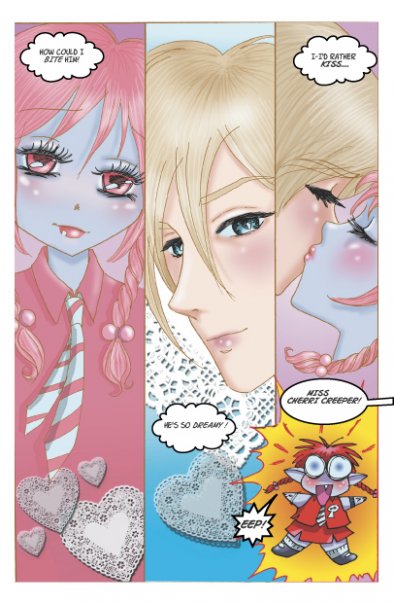
That url Holly shared for you up above? www.schoolbites.net? You should go there and enjoy.
Tuesday, February 28, 2012
I Have to Enjoy What I Write - An Interview With Trina Robbins
It was through Naropa people, during my mom's attendance at the Summer Residency program, that I learned of Trina Robbins and her work – okeh, I take that back; I had seen her work before then, I knew what Vampirella looked like, I owned four out of six issues of Misty, but I did not put it together as a body of work. I definitely didn't connect the émigré from Drakulon and Millie the Model's niece to a short, sharp black and white comic in the back of a San Francisco zine my mom left lying around the apartment when I was nine, even though that (what I now suspect to have been illegally reproduced) comic was prefaced with a bit of hype naming Trina Robbins. For one thing, that zine referred to her as a “girl” who made comics, which to me, as a kid, meant she was a kid.
A table of poet-professors trying to illustrate to me how to trace elements of an author throughout their work used the two people they had something by on hand and the two that stuck with me ended up, for whatever reasons, being Trina Robbins and Clive Barker. This was also the first time I remember recognizing the Peter David tropes and tendencies that put me off his work, the day I started looking for Tatjana Wood's name in credit boxes, and when I realized that what had been a disparate set of movies I was probably too young to have been watching but had seen anyway were, in fact, all directed by David Cronenberg.
Yes, I'm the only person on the planet who auto-associates the remake of The Fly with Trina Robbins and Millie the Model.
Travis Hedge Coke: “How responsible do you feel about the contents of comics you work on? Responsible to your audience, to comics history, or to yourself.”
Trina Robbins: “Very responsible! Recently I've been writing graphic novels for young readers, anywhere from 8 years old to teens, and I make a point of NEVER writing down to them. When I write for kids, I still write for myself, and I have to enjoy what I write. If it makes ME laugh (or cry) then it's good. Also, something I only realized recently, because one of my editors mentioned it, my scripts always have a lot of diversity. There's a story that used to go around about Chris Claremont, one of Marvel's better writers, that if he had to introduce a new character, say, a cop, or a teacher, or whatever, he always said, "Why can't it be a woman?" and I go one step further in my scripts and say, "Why can't it be a black woman or an Asian woman?" I've given my young white heroines black or Asian friends, but, after getting rejections on a graphic novel I submitted with a black heroine, never tried again to script a graphic novel with a black heroine until my editor actually suggested it to me for the most recent graphic novel I wrote -- and I was delighted! “
Hedge Coke: “Have you ever been part of something in a comic that you couldn't have imagined would get anyone's dander up, only to be cautioned by someone above you at the publisher or find it enraged folks after publication?”
Robbins: “Ironically, considering my reputation as a feminist, I've been criticized by much more radical women than I for having pretty girl heroines. At an appearance in a women's bookstore in Stockholm about 3 or 4 years ago I was verbally attacked by a very angry group of women with shaved heads because I wrote Barbie comics. At first I was so surprised that I tried to answer them rationally, but by the end I was so mad that I was shaking with anger, and when I got home I sent them an email care of the woman who owned the bookstore, telling them that if they didn't like what I did, to do their own damn comics.”
Hedge Coke: “Have you ever seen someone's contribution to a comic you worked on and been, if not offended, concerned about some content of their contribution?”
Robbins: “Not sure if this is what you mean, but I've been writing some comics about a certain heroine from the 1960s in a series that has other comics in the same series written by at least one other writer and drawn by a different artist than the one who illustrated my issues, and I was a little annoyed to see that the artist drew the heroine with enormous breasts and that the book contained graphic sex scenes. I had tried to keep the ones that I wrote in the spirit of the period, which meant no graphic sex, and anyway, I thought the graphic sex and enormous breasts were in bad taste, and I didn't like the idea that since I had written other books in the series, it could be associated with me . In the distant past when I drew underground comix, it used to annoy me when people would describe my comix as "dirty" because they were associating my work with all the graphically explicit underground comix.”
Hedge Coke: “What elements of a comic do you try to focus your attention on most?”
Robbins: “Of course I'm a writer, so: plot, characters, humor, action. In other words, all of it.”
Hedge Coke: “Have you ever toned down something - or thought about it - because you were concerned it was going to be seen as you pushing an agenda/fetish/interest and not a naturalistic part of the comic?”
Robbins: “I don't think so. I do try to say stuff without being preachy!”
Hedge Coke: “How much do you draft and tweak before the publishable versions of most of your comics work? Do you feel you get better if you revisit a page or a story several times or is first shot best?”
Robbins: “I tweak like mad -- I go back at least three times before I'm satisfied!”
Trina Robbins is the author of many fine comics and books, from fiction to confessional to histories and encyclopedias, including two books on the magnificent Nell Brinkley and two different Wonder Woman comics. Recent works include a Honey West series and her Chicagoland books.
Thursday, February 9, 2012
Clearly and Dynamically: An Interview With Chris Burnham
Clearly and Dynamically: An Interview With Chris Burnham
When I first really took note of Chris Burnham's artwork, I wanted him to have thumbnailed the hell out of his layouts and arrangements for every panel, each page. It could be an innate genius for mise en scene and balance, but I didn't want it to be. There may be some beauty in it being effortless or accident, but I was immediately struck with this strong, probably irrational desire for it to be work.
After recognizing that it wasn't up to me how he worked, I settled into simply enjoying and analyzing his comics. I think I have a better sense of the space between lines since first encountering Chris Burnham's artwork. I know that, directly tethered to my enjoyment of his work, I have a renewed appreciation of “filmic” techniques in comics storytelling. Burnham paces scenes in a very storyboard fashion, but he seems considerably more aware of the shape of a page, what the panel arrangements themselves communicate to his audience.
And, in Batman Inc, Burnham drew the most recognizable reservation that I've seen in a comic in I don't know how long. Maybe, ever. It was a shitty-looking rez, in many ways, but well. It was shitty in the right ways, as opposed to, for example, the much-loved-by-others Jason Aaron and R. M. Guéra series, Scalped, or the wonderfully written (by Kurt Busiek) but full of disappointingly kitted Indians Strange Tales. Often, “attention to detail” in terms of comics means lots of shading, crosshatching, and drawing in every rivet and brick, but representing a place, or a kind of place, so that it can feel recognizable and right to those unfamilar and quite close, that's a different and substantial kind of attending.
Travis Hedge Coke: “How responsible do you feel about the contents of comics you work on? Responsible to your audience, to comics history, or to yourself.”
Chris Burnham: “I definitely feel a responsibility to make the absolute best comic I'm capable of. I'm still a huge comic fan and it pisses me off to no end when creators fuck up an otherwise good comic with distracting mistakes. I want to make comics that are good enough to withstand criticism by the nitpickiest asshole alive... me! (Whether I succeed is another story, but if your reach doesn't exceed your grasp, you're not trying hard enough, asshole!)”
Hedge Coke: “Have you ever been part of something in a comic that you couldn't have imagined would get anyone's dander up, only to be cautioned by someone above you at the publisher or find it enraged folks after publication?”
Burnham: “This certainly seems like something that would happen a lot to me, but the only examples I can think of are Elephantmen #16 and the Marvel Mystery 70th Anniversary Special. In Elephantmen, Rich wanted a sex scene that was somewhere between the classic Steranko Nick Fury and Contessa scene (the one with the gun in holster) and a scene from Howard Chaykin's American Flagg. I took it WAY too far. I did 9 or 12 panel page that, while not explicitly showing penetration (or even nipples), was basically soft porn. I remember lovingly drawing what I thought was a subtle rim job. Haha! What a moron. When the scene saw print, Rich took the 6 tamest panels and edited them together. It worked a lot better that way.
“On Marvel Mystery, I had the Angel bashing someone's face against the wall, and he was completely covered in blood & broken teeth. After it was colored, Tom Brevoort thought it went too far and had me redraw the face without all the blood, and Nathan Fairbairn recolored it... but for whatever reason the production guys never got the memo and the gory version is what saw print. Hahaha!”
Hedge Coke: “Have you ever seen someone's contribution to a comic you worked on and been, if not offended, concerned about some content of their contribution?”
Burnham: “Err... I wouldn't say offended in the sense that they were making racist rape jokes or anything, but I've certainly been involved in a few comics where I thought the other guys dropped the ball creatively. (And I'm sure there are guys who thought I did the same.)”
Hedge Coke: “What elements of a comic do you try to focus your attention on most?”
Burnham: “I'm most concerned with telling the story clearly and dynamically. I work really hard at making sure the characters are distinct from one another and their actions are clear, setting the right angle, picking the right composition, leaving enough room for word balloons... all that stuff is primary. Noodly details and perspective tricks etc, while fun to do and look at, are secondary to the storytelling. (This is, of course, in an ideal world... many times I'll get distracted by trying to nail some weird perspective or setting at the expense of putting the people in the right place. Oops!)”
Hedge Coke: “How much do you draft and tweak before the publishable versions of most of your comics work? Do you feel you get better if you revisit a page or a story several times or is first shot best?”
Burnham: “I spend a varying amount of time doing Photoshop tweaks on each page. Ideally I'd get it right on the page, but I don't see a problem with going in and monkeying with things to make them a little better. Once in a while (like, every few months) I'll redraw a panel from scratch after I've taken it to pencils or inks. Most of the time I catch those problems early with obsessive thumbnails. On particularly tricky pages I'll do multiple sets of thumbnails that tell the story in different ways and then pick the best option between them. The hard part is when I like parts of one page and parts of another, but their panel compositions are mutually exclusive. It can be like picking which one of your children gets eaten by wolves. Sorry, Billy! ;D”
Chris Burnham will being doing twelve issues of Batman Inc with Grant Morrison in the near future. If his progress so far is anything to go by, and his work ethic, he will continue to be an increasingly exceptional artist and comics-maker.
Sunday, February 5, 2012
Ethics and Choreography: An Interview With Larry Hama
Most people know Larry Hama for the Eighties reworking of GI Joe that's still spawning big blockbuster movies, or his recent comedy roman a clef, Barack the Barbarian, but I didn't read GI Joe when it was coming out and I was a kid, and we had Reagan and Bush back then. For me, Larry Hama was a Wonder Woman editor, the creator of Bucky O'Hare, and the writer of one of the best comics ever published, Nth Man. Larry Hama was a man who wrote casts of characters who were diverse in their politics, their ethnicities, their backgrounds, without anyone being a cardboard target or well-meaning stab at a “kind” inclusion, the token presence. And, between interviews, anecdotes, and his work, he seemed cool. Hama acknowledged what government positions and ranks, pay grades and titles like Doctor and Colonel, actually meant in ways that few writers in popular entertainment ever do, outside of titles they have used professionally. He managed to communicate more to me about humanity in Nth Man, which has never been reprinted, and his time on Wolverine, than Moore and Gibbons' Watchmen or any bit of Cerebus.
Today, more broadly familiar with his oeuvre as a writer (of fiction and nonfiction), actor, editor, photographer, and penciller, having had the chance to ask him questions directly, to see him with the eyes of an adult, he still seems honorable, sensible, and cool.
Travis Hedge Coke: “As an editor, penciler, writer, and probably everything else in comics, you've done work for very different markets over your career, from Sally Forth and International Times to GI Joe, Batman, and Bucky O'Hare. Do you deliberately tailor your work to the kind of publisher or the perceived market? Or, does it happen more naturally?”
Larry Hama: “95% of what I have done was work-for-hire, and done to please whoever it was that approved the check. I always saw myself as a working-class guy, and not an 'Artiste.' But I was brought up to believe in value for honest wages. I try to give it my best shot if I own it or not. I think I should basically give the audience what they want as long as it doesn't violate my own ethical concerns. I have a problem with vigilante justice, so I have to figure out alternate story angles when I did a character like Batman, so as not to accentuate that particular bent of the character.”
Hedge Coke: “How responsible do you feel about the contents of comics you work on? Responsible to your audience, to comics history, or to yourself.”
Hama: “It seems rather pretentious to be concerned about responsibility to comics history. The main responsibility I feel is to give the audience an entertaining read. I'm not out to preach, or send an overt message. I'm against war, but for the soldier. That doesn't blare out from the pages of GI Joe, but is a theme that runs throughout the extended narrative. If I am taking over an already established character, I feel responsible to the perceived history of that character. If I make any changes, it is usually to amplify what I feel is already there. I feel that is what I did with Wolverine. I objected strongly to the 'bone claws' arc and did it under duress, because it was agreed upon by the majority at an X-conference. It never felt 'right' to me, and I couldn't understand the logic of how that worked.”
Hedge Coke: “Have you ever done something in a comic that you couldn't have imagined would get anyone's dander up, only to be cautioned by someone above you at the publisher or find it enraged folks after publication?”
Hama: “More times than I can recount easily. No matter what you do, somebody out there will take offense at it. I named a malignant computer program 'Shiva' in Wolverine and because a single Hindu kid wrote in, I had to kill the rest of that particular arc. It wasn't even a character, it was the acronym for the application. And then of course there was the outcry from paranoid-schizophrenics about Zartan. A friend of mine, who is shrink, said 'what did you expect? they're PARANOID.' Jay Leno (before he hosted Tonight) went on Letterman and did a whole routine about how he was offended by the Dreadnoks being bikers.”
Hedge Coke: “Have you ever seen someone's contribution to a comic you worked on and been, if not offended, concerned about some content of their contribution?”
Hama: “I can't get bent out of shape about what happens to characters after I leave them. Everything will get eventually undone by people who figure they can make it 'better.' I avoid reading all of that stuff.
“Have not read a single issue of Wolverine since I left the book. (they stopped sending me bundles, and I don't go to comic shops and buy any.) I have never watched any of the GI Joe animation, either. For years, I was puzzled by people who came up to me at conventions and said 'knowing is half the battle.' I was like, 'um... sure.'”
Hedge Coke: “Does Nth Man still have enough to say, still do enough, in your opinion, to warrant a reprinting/collection? Do you think the ethical considerations embodied by the main characters are more or less valid today than when it was originally being serialized?”
Hama: “The ethical conflicts of the characters is what the Nth Man was really about. All the rest was just choreography. I had to cut it short because it got cancelled, but I had enough warning to wrap up most of the threads and bring it around to the rinse cycle like I had planned from the beginning.”
Hedge Coke: “When Ben Grimm and Logan came out, a comic you wrote about a pre-Fantastic Four military adventure involving some classic Marvel heroes, there was some outcry over (future Ms Marvel) Carol Danvers' introduction. She's got her arms over her head, chest out. That she's as competent as anyone in the story, well-used for her job – probably the only Carol Danvers story with an explicit understanding of what the NSA is and who works for them - and as a foil to the other characters (especially enemy agent, the Black Widow), that was where it stopped for some folks. Any thoughts on that?”
Hama: “All I can say is that an awful lot of women have thanked me for doing tough competent female characters that were in direct contrast to the bimbos with their palms nailed to their foreheads that were prevalent at the time.”
Hedge Coke: “I believe you were involved in the Wally Wood deal, 22 Panels That Always Work!! (which I would say was a nonfiction/instructional comic, itself, really, and one that always works), which seems to add fuel to the kind of people who want to take shots at Wood for being lazy or cheating. "Oh, sure, it looks great, but he cheated" and so. Can you say anything about either that twenty-two panel guide or shortcuts in general?”
Hama: “First off, anybody who thinks Woody 'cheated' is way off base. WHO are these people who take shots at Woody for being lazy?? Dollars to donuts, they are nobody you ever heard of. I compiled those 22 panels which were actually on three sheets originally. I had the Marvel stat room resize the frames to fit on one 8X10 sheet and I lettered the title and sub-heading with my own editorial comment which was a snide dig at writers. I ran off a hundred copies and kept them in my office to hand out to prospective pencilers. After a while, other editors asked for copies to hand out and it sort of spread. Joel Johnson now owns the original paste-up and you download a pristine digital file of it from his blog.”
Saturday, January 28, 2012
What Do You Mean She Lied?
[A modified version of what would have been a Pop Mechanics! column for Renderwrx. Dedicated to Gene Colan, who died as I was writing this.]
"Since most people who cite a "convoluted mess" in regards to Grant [Morrison]'s work turn out not to be able to pass a high school English comprehension test, said citation tends to be viewed as comedy." - Warren Ellis
Comics people seemed trained to accept only direct, truthful statements, usually reinforced or reiterated at least once more beyond the initial. Better prominent people than me, from Tim Callahan to Grant Morrison, have addressed the gist of this, but I find their coverage often wanting or misdirected, though certainly serving their purpose of their moment.
"Schizophrenics can't process metaphor" has become a joke phrase, a meme to bust out and kill a conversation with a laugh. As with Mark Millar's "My God has a hammer" the phrase has no connection to comics for a number of folks who use it, and even when it does, no connection to its creator. Morrison used the phrase to describe a lack of reading skills beyond the literal, to indict readers who claimed there was nothing beyond the "literal" representations of a dead talking flying tuna with a cigar named Chubby who acts as the animus of a guy vying desperately for a girl with a beard who could, by just standing with him, help him seem like he belonged.
Here is where we have to careful in making clarifications. Failure to see strongly implied metaphors or to notice even in retrospect when a character was wrong, intentionally (lying) or unintentionally (misinformed, confused), is not the same as not enjoying it despite acknowledging those elements, nor is it the same as believing those to be poorly done. It is not a judgment on what anyone enjoys, to point out when a major factor of a work has been missed by a criticizing or lauding audience.
We all miss something, sometimes we are meant to not recognize what is in front of us, in terms of narrative, characterization, or metaphor, until we look back with knowledge we will find on another page. And, none of us enjoy being reminded of a lapse in our critical faculties, in our ignorance, though we are all ignorant of something.
I once saw a guy fall into a rage because he was sure someone was making fun of him when at the end of From Dusk Till Dawn, in the bar in Mexico where our characters have just spent the night, Cheech Marin says he has both kinds of beer, "Mexican and domestic." See, this angry fellow had seen the movie before, and it only now registered to him that domestic beer in Mexico, is Mexican. He didn't see a quick joke, he didn't see a moment in a scene that requires a dialogue beat for pacing, he saw the cast and crew of a major motion picture fucking with him.
Don't be that guy. Especially if you are talking to people who caught it before you. And, don't be the gal who, when she still doesn't get it, insists anyone who does is lying to make themselves seem smart. Humanity as a whole, and most human beings, have never benefitted from these responses, and I can make up imaginary statistics to demonstrate the truth of that. We are all ignorant of something, ignorance need only ever be temporary, and the goal of entertainment is most often not to insult you when it fools you, but to entertain you when you realize you were taken in.
Let us keep back from metaphor and themes for now, and focus on the objectives of characterization, particularly, the subjective element(s) of the individual character. One of the refreshing things about the changeup in the X-books when Joe Quesada was first Editor in Chief at Marvel, was that writers like Grant Morrison and Peter Milligan allowed characters to lie without clueing in the reader, and more, they wrote characters who believed and acted in ignorance.
One of the earliest scenes in New X-Men (Morrison & Quitely) was a dentist who has educated, documentary evidence what he is being told and shown by the villain Cassandra Nova is wrong, but all she has to do is belittle his education and play to his desire to believe things were negative and violent. When Nova and this dentist act on the "knowledge" expressed, she is lying and he is misinformed, and this is left implicit. The reader who is swayed by her misanthropic ploy, who is more comfortable with a negative, violent, selfish truth than a more pleasant one, is left with that truth. The X-Men themselves come to see Nova in the same terms, as negatively as possible (she does commit genocidal acts and generally play the horrible villain, but there is no real evidence she is an evolutionary mechanism for extincting species). Only Charles Xavier, ever the optimist decides she is designed to motivate everyone out of stalemate. And, he too is wrong.
But, because there is never a panel of someone declaring "I was wrong!" or "She lied to me!" you still get people on message boards discussing the ins and outs as if the writer dropped the ball, as though Morrison must have forgot "his" previous position when another fictional character in the story has a different conclusion, almost as if individuals have their own perspectives. Because there is never a simple, declarative "Cassandra is Ernst" we have at least two respected, intelligent writers get it wrong in follow ups?
The most frequent way to cover yourself, in a comic, is to make sure the visual and the text elements say the same thing clear and direct, which Scott McCloud calls "duo-specific." Claremont was often duo-specific, describing a superhuman attack as we see it or captioning in details for a relationship as we see the visual actuation of the same. But, if he wanted something to sail by without everyone catching on, we get "leman" deployed without accompanying verification or support.
And, when you want something to be memorable, duo-specificity can be your friend. Studies show most people do retain information better when taking it in as text and as visual, hence most instructional pamphlets. But, at some point a level of sophistication may be justly expected, perhaps, in that objectivity becomes an unnecessary affectation or the reader can infer an authorial morality behind the structure of a character's voice; perhaps the reader's morality or experience can be trusted enough for an absence of authorial voice (as best can be managed).
It is anticipated by some in entertainment, that this level of sophistication should always be presumed missing or rare. Vladimir Nabokov uses the first chapter of his novel, Ada or Ardor, to dissuade children and lazy readers from sticking it out just for the dirty bits, Steven Spielberg has yet to direct an adaptation that can't refit the men as bad-parent types, and dozens of childrens activity books will still indulge in ethnic dress up games so long as the ethnicities parodied are sociopolitically still safe for it.
But, comics? Comics are for kids. Probably why, when free speech won out in the Seduction of the Innocent case, comics got a self-elected regulating board and a set of rules stricter than those of any other medium in American history - and everyone behaved as if it were law and not just marketing. Crime must be punished at the end of every story, vampires and zombies are a no, violence is grand but no representative of law must ever be injured, passion must never stir the "baser emotions" and respect for parents and law-enforcement officials must be paramount. Regulations for all comics, not only those aimed at children, at virtually the same time was the Hays Code was being revised in acknowledgment of how detrimental heavy regulations were socially (and economically). Because, comics are for kids and even if they are not, the audience will be treated as children and learn to like it!
Not to disagree with Alan Moore, in his observation that Stan Lee introduced the two-dimensional characterization and the first deliberate symbolism into comics, but is that true? A lot of EC stories seem to have characters as developed as those of Marvel in the early Sixties. Wonder Woman has great symbolic relevance conscientiously applied in her early comics. So, is it that Lee reintroduced these elements after the Code and times bled them away? Blondie had gone from comics where things happened and had relevance, almost in reflection of the whole of the American aspect of the medium, to a dull, staid sequence of safe repeating gags by the Fifties (as it has remained, looped, since). Spider-Man reads not entirely unlike Blondie did back when they still made movies about her and her sandwich-enthusiast of a fellow.
Romance comics as well as paranoia comics (same fish with less bug-eyes and sweat?) required at least two-dimensional protagonists long before the Marvel revolution, so perhaps it is only that from Fantastic Four forward, Stan Lee and the Marvel writers to follow applied these innovatively to superhero comics. Moving as those comics could be, they still kept to considerably more adolescent material than the admittedly pretty adolescent EC crime and horror books or the comedy romances like the magnificent Millie the Model or Patsy & Hedy. I would not be the first to suggest it took a low opinion of the readership (accurate though it may have been) for Roy Thomas to take the awesome that is the early Black Panther and strip him of his culture, his political clout, genius, social standing, super-technology, and FF-whupping level of badassery... to make him safe enough to feature regularly in The Avengers. (And, when Panther leaves the Avengers, for Jungle Action, the first thing he does is remind them he's fantastically rich, has mad supertech, and can leave. Go fig.)
It may not have been a too-low call, sadly, depending on what readership is being pursued. Let's assume someone out there does need DC's Mr. Terrific, say, to be "the third smartest man in the world." Did they need to bill the white Mr. Terrific as such? But, this hypothetical audience DC is courting do need it of a black Mr. Terrific. Well, there is another audience that can handle "the smartest man on Earth." Beyond, there is an audience, myself included, who believes that if the selling point begins "smartest" that changing that up synchronous (if not consciously connected) to other changes, such as race, is a bad plan and counter to the ethos superhero comics taught me.
Batgirl can't get past brown belt. Mr. Terrific is the third smartest. But, no matter who is actually faster or equal to the Flash, he is always "the world's fastest man." Sometimes, we the readers and we the critical aspect of comics culture - the academics, analysts, and speculators - sometimes we act in ways that encourage treating us to these gestures placatory to heteronormative and homogenous artifice.
From Anarchy for the Masses: "Robin's autocritique acknowledges that she is undermined by her appearance. She stands for revolution but is instead only seen as a sex object. Note that despite this realization she doesnt stop dressing like a hooker." That was written by two smart, savvy individuals, Patrick Neighly and Kereth Cowe-Spigai. They don't seem to notice what they have done, there, and neither do the people who call Wonder Woman's jacket whorish or say a version of Cyborg looks thuggish, muscle-brained, or gangsta, particularly the one for the upcoming JLA relaunch, where he is, in terms of body and body language no different from any other man on the team except in that he is black.
Taken from a different angle, the same problem of presumptive judging turns into a lack of emotional affect (to be PKD about it). Readers do it enough, and you get writers and artists playing to it, editors prescribing not relational emotions from characters, coming causally from the events and dynamics of their lives, but emotions as a sell. Why else do you think Aquaman is ecstatic while his life, marriage, and political position fall to bits during Erik Larsen's run? There is an editor who knew a readership existed who would see a smile and believe it, regardless of context. An audience does exist who read Robert Crumb's My Troubles With Women and believe the bravado, who are still distressed not by the rape of DC's Nightwing, but because he stopped smiling for awhile after the rape. Kurt Busiek or Mark Waid can write wildly modern work, from dialogue to character tics and plotting, and there will be cries from the Neo Silver Agers of "Seen it! Recycled from 1967!" while Grant Morrison lifts point for point at Agatha Cristie plot or entire passages of an old Batman comic as with Joe Chill in Hell and it's "Too new! Too difficult!"
See also the people who criticize Devin Grayson as inappropriately pushing her personal fantasies into a corporate comic in the same breath as lamenting Jim Balent not drawing Catwoman comics these days. Or, who get put off by how contrived a cast mostly not of white American men is, but not any nearly all-white, all-male, all-American one. Concoct reasons manga isnt comics. Erase Ramona Fredon or Marie Javins from comics history to maintain a "no women" illusion. Who feel Alan Grant was wrong for telling an audience of fans that the Vice President at DC was outright lying to them. This is who is at fault when comics get done, get published in ways that treat any reader as a subnormal child.
As a collective audience, our reading comprehension, our analytical and judging faculties are at fault. Any one of us who opens a new comic and declares any answers not on page one are nonexistent, that deny the metaphors or themes the author and/or six thousand other readers have found, who believe a flashback or a non-narrative illustration are violations of the natural order only fit for mediums other than comics. Readers who don't let comics be grown up or ever mature are at fault whenever a critic, a country, a printer or colorist decide we, the hypothetical audience, the hoped for pre-actuation audience are not to be trusted as sane, aware, self-governing adults, but must be coddled, kept from dangerous stories, kept from dangerous ideas or ideas unpleasant to us even if that unpleasant feeling is rooted in bigotry or idiocy.
The Comic Book Legal Defense Fund is currently raising money to defend Americans who brought illegal comics to Canada. Canada - and to a lesser degree, the United States of America - many nations around the world believe we are not mature enough to handle some kinds of fiction. Censorship of entirely fictional things always means the people the fictions are being kept from are thought to be incapable of handling them maturely. And, it's our fault, because we dont decry censorship enough and because some of us, a very vocal some, read a comic by Kevin Smith and put it down believing Smith wrote Batman wetting himself.
They read a comic wherein Batman tells someone he had an involuntary bladder spasm years before the telling, due to an explosion. In the comic they read, Batman tells - tells - a story. A story someone tells inside a story is discussed as if it were the story, as if it were witnessed firsthand by the reader. That's how lazy it gets.
There is no shame in getting swept up and realizing you were a lazy reader, that your analytical faculties were put on stall for awhile. I have been there believe it. Whether the affable justified-homocidal grandfatherly scientist in Cannon God Exaxxion (Kenichi Sonoda) was meant to be taken straight, accepted positively, marinated in my concerns every new chapter I imbibed, and still today, I just do not know. Planetary, which I have the gall to annotate, was nearly complete before I added one two three and realized that Jakita Wagner has Superman's origin. As a kid, I thought Dan DeCarlo did not know when he was being dirty. There is no shame in realizing your analysis engines were not firing on all cylinders, but there is in not self-correcting at the realization.
Are you a reader who saw no symbolism in Seaguy? You don't have to enjoy the comic, but please, read it again so you can see the symbolism this time and judge it with that fuller picture. A critic calling comics art "dross" while reviewing Kenneth Koch's anthology of "comics mostly without pictures" who admits to not reading comics? Go to the appropriate shelf at a convenient bookstore and start opening different comics, just to take in the breadth and walk away with learned scope and not the inference of memory. An editor, writer, artist, flatter or any other kind of comics-maker, who has seen the ugly, the dumb or disappointing in comics readers or comics press? Do not let that encourage you to make comics you would be insulted to read, that garner you even massive sales if the sales come from an audience you cannot be proud of or relate to.
Sunday, January 22, 2012
If You Don't Weaken
[Note, this would have been the next Pop Mechanics! column to run, if Renderwrx had not gone on extreme hiatus. Due to developments since then, a postscript/addendum will follow.]
The inestimably cool James Baker wrote the other day, that "X-Men: Prelude to Schism has that wonderful 'We Who Are About To Die' feel that almost all stories ruin by going on to have an ending." And we are talking ongoing X-Men, here, not a standalone, not a non-canon or alternate universe tale, but "to be followed by another twenty plus years of narrative on a regular release schedule" X-Men. And, that is sad, that the feeling of "now, everything changes" and apocalyptic shit hitting the fan is inevitably muted by awareness that it will all get patched up and staid soon enough. Who wants to stay in the water if you know you are riding the last wave of the season?
Even in standalone works, the idea that everything settles in the third act can be disappointing, and that the world will return to normal after the end of the story seems, between Post Traumatic Stress Disorder and social extrapolation, a cheat. It is a cheat, only it is a comforting cheat, so we often enjoy it despite the nag of its irreality. I was disappointed when I recently learned the massive launch post Brightest Day at DC was intended to come after Final Crisis, while the Milestone stuff was being integrated and relaunched. But, Final Crisis did something better than that wave of new titles, for my money, ending with public acknowledgment of alternate realities. It ends with a news broadcast that will alter consensual reality and tells the audience at home that "This is one story that is only beginning."
Fiction is traditionally unkind to the public. If everyone gets a jetpack or a torrid romance, they are no longer so special, is the reasoning. As You Like It, is often maligned opposite other Shakespeare plays because every character, even passerby, have crazy epic shit going on in their lives. I love Ophelia and Laertes, but they are undoubtedly at service to _the important people_ and nothing in Hamlet trickles down to the commoners.
The implication of public hows and whys is rare by the end of almost any fantastical story; Zardoz to Alien, the fantastic element is most often isolated by the end and as unexplained as can be managed. When something posits vampires as a disease, for example, it doesn't mean anything but the semantic prosody of "disease." Xenomorphs must be isolated in each film (the fourth Alien might have bucked this), by the end, just as Frankenstein's creation must have a castle dropped on him or be frozen in ice by the end of each of those stories. Followthrough, should be avoided as it takes their culture away from ours, which never changes.
You see the flaw? That idea of a suspended, immutable reality may be comforting - You want to live in a pre Civil Rights Movement United States, though? How about pre vaccination France? But suspended in an era/culture under regulations of fantasy logic, dream or hope logic, it can be comforting. And, while fiction is comfort fiction, not everyone can feel the special case apart from the common public.
In a previous Pop Mechanics, I mentioned a Wolverine comic where the hero was prevented from stopping an act of domestic abuse. The X-Men can't go fixing real things like a husband terrorizing his family, that's a "real" thing, different from liberating nations conquered by Magneto or having tantric frenzies with Apocalypse. So, too, Superman cannot gift the public with amazing Kryptonian technologies, not even some simple ones like the coolest Kryptonian poetry or their best musical instrument.
Superman does not walk in the commoners world, and as a recent way-too-wrongheaded story, Grounded, demonstrates, when he does choose to enmesh himself in _us_, Supes does so by pretending away his special talents and knowledge. He walks, instead of flies. Now, I am for reasons medical and social a walker, I don't drive, and right now I live somewhere with atrocious public transit. Most people do not walk, in America - it is unamerican. They drive. They take buses, airplanes, trains and if they aren't driving their own vehicle, they are riding in someone else's. They do not walk across the country only using their talents to harangue poor communities for their plights and physically intimidating journalists for asking them why they are walking across the country. Why don't we walk across the country if it could be enlightening? Not being able to afford it, is probably a big easy answer. Because leaving our friends, families, lovers and local community for extended periods of rumination and self-examination could be considered selfish. Because we do not need to. Pick one, you will be unlikely to be wrong.
A king who dresses as a pauper to walk the streets indulgently for a weekend is still a king. Right? There is a Pulp song about this. It's really mean and William Shatner covered it. But it is not required that Superman be a king who dresses down feel "real life." I believe, when Warren Ellis wrote (in Terra Occulta) a non-Superman Clark Kent saying "I'm a newspaperman, I'll take a vacation when I die," that he means it, he gives a damn and feel a part of the world. Same when Louise Simonson writes the character, either as Kent or Superman.
A criticism of the Daredevil movie - and I think they lifted this from when Annie Nocenti wrote the title - was when the hero is going to bed and can sense people in danger, people dying, and goes to sleep anyway. The hero can't! But, what is he going to do? He is beat up, he is tired, probably hungry and PTSD already. Exhausted. And he is just a guy in red leather punching folks in the street. The same complaint was levied against Alan Moore and Kevin O'Niel's Black Dossier, when Alan and Mina, two brave but not rich, not powerful, and terminally disenfranchised people did not even try to overthrow the post Big Brother culture and government of their Britain.
Also from Terra Occulta, from the first page: "This is a fast world I live in now." And that is from a forced expat, their version of Wonder Woman, who follows it up with, "I want to go home," having, of course, no home to go back to. Like most of us, she has only this world, the job and the local mall and the jogger who runs by every day around ten with the same music faintly detectable on their earbuds as they pass, politicians we may not have elected in office, traffic jams we cannot control, neighbors we cannot choose and cultural judgments that continue whether we care for them or not.
The couple from Black Dossier are the family the X-Men stop Wolverine from helping. Warren Ellis' Clark Kent is the guy J Michael Staczynski's Superman physically intimidates or browbeats with inaccurate history rather than respond to as another competent adult of equal cognizance. Louise Simonson's Superman drinks Soder Cola and Mark Waid's sees animal life as all so close, he won't eat meat but does not begrudge it of others. The Sookie Stackhouses and Robyn Slingers of fantasticka. The woman who finds listening to seven seconds of a Prince song better ten times a day than the MEEP MEEP or RING RING of a traditional phone ring, not Prince, who can afford to live without a phone and does not appreciate musical ringtones.
To carry the Common People comparison, when Grounded ends, Superman will have learned nothing not superficial, any growth will barely be referenced and the world he inhabits will appear absolutely the same was before. When the groups represented by the protagonists of Hellboy or Ghost in the Shell do their job right, or those of X-Files and Fantastic Four (Future Foundation, natch) do their job halfway, the public is spared the fantastic. Or, as Planetary spelled it out, _deprive_ the public. The fun toys are for our betters.
A great move by Jack Kirby and Stan Lee with Fantastic Four was that the public wanted them to keep all this new (and newly-apparent) wonder to themselves. The people who live in the Fantastic Four's neighborhood want the FF to keep themselves locked up and quiet. Alan Moore, together with Gene Ha and Zander Cannon, inverted this about ten years ago, by ghettoizing the amazing literally, moving all the superheroes, robots, monsters and magic to a single city for ensemble police dramedy Top 10. Isolating the fantasy is also the business of the sell from the protagonist of Doktor Sleepless, "Where's My Fucking Jetpack?"
Eventually you get the jetpack, or you see the other guy with his jetpack, and jetpack technology is extrapolated in non-jetpack directions, there are styles and brands, there are related myths and cultures and symbolic relevance that changes because of a prevalance or avoidance of that piece of the fantastic that has entered the world.
And, maybe Lee and Kirby got it right with the inference in Fantastic Four, and inference that grew in early X-Men to become the defining thematic factor of the X-media empire. Maybe, we do - as a public, as a culture - prefer to isolate the different, the elements whose existence, the acknowledgment of which put the lie to consensus reality. They were right about something else, too. Nothing stays ghettoized, censored art gets experienced, silenced people find ways to talk. Attempts at genocide can be horrendously successful, but they fail.
To paraphrase another X-Men comic, getting back to Grant Morrison, "Nothing ever stays buried."
Especially in serial narratives, but in all fiction, there should be denouements but never endings. If you put out there a set of memes, a frame of ideas, and then try to put the fullstop on it, what is that? Were your ideas too weak to keep up? Are you implying you are stalling out or scaling back because the audience needs that, wants that? Conflict generates refinement, so do not dissolve the conflict - Dissolution of the conflict and ghettoizing of the hypergolic elements is what ends a story.
Grant Morrison managed a beautifully romantic denouement to X-Men with Marc Silvestri, called Here Comes Tomorrow and the issues that immediately followed felt entirely like spinning wheels and desperate bids for nostalgia. Nostalgia is not gas, nostalgia is smelling the gasoline that is gone and remembering what the fuel was like. Chuck Austen spending two issues solving a mystery that had already been dealt with and Chris Claremont wrote baseball. Like he was shouting "Baseball!" to distract us, almost. He could have just had the characters yelling "Mother!" and "America!" a lot for all it fumed of nostalgia and desperate security.
Warren Ellis had some experience writing worlds alternate to a baseline fictional world from his time as Excalibur's writer (during which, he spent four issues or so doing the Age of Apocalypse horrorshow of global genocide, slavery, and blues bars), but when he looks at alternate worlds in his Stormwatch story, The Bleed, he has his regular cast see the alternate and be directly motivated by it, while also giving a gorgeous happy nonending, in a man on a cane walking arm in arm with a beautiful girl to lead an army of superhumans up a staircase into the sky to save us all. His alternate Justice League from the aforementioned Terra Occulta or the Batman of its sister story, Night on Earth, keep the idea complexes of Superman, Batman, and Wonder Woman using different conflicts to prove the vigor of the memes. Age of Apocalypse, though? He wrote some of it, was not in charge of it, and when it ended and "real"/"right" reality was reasserted, pretty much every interesting idea it brought to light faded immediately away.
Chris Claremont kept things moving forward for a long part of his initial X-Men run, though he found some comfortable spots of maintained ignorance, like the pretense of a reasonable or understandable Magneto. When he dipped into an alternate world or possible future, it fueled the main reality, ideas and people and things leaked in, from the dystopian Days of Future Past to the wholly imaginary Kitty's Fairytale. His returns were all competent but good at defanging all the ideas, at stalling progress... except when he wrote outside the canon for The End. X-Men: The End moved things forward faster, put the conflicting elements against each other harder, and tested and adapted and retested ideas more vigorously than any canon X-story Claremont has written in most of my lifetime. It had to get to the "end," the future, and his canon work seemed designed to avoid that, to keep a today with no tomorrow, no "and then what?" because asking for the "and next" means things would have to change.
"And-Next Fiction" is a jargon term to devalorize some fiction but it is, as a technique, honest to life. Life is and-next. Nocenti's Daredevil run was almost entirely and-next and mostly things that the prevailing concept of Daredevil dictated he had no business being involved with, such as wandering PTSD and grieving through Hell come to Earth and the Devil's son messing with his head. Life bleeds over, it seeps through, it keeps being there, though, and if Daredevil is going to live in the Marvel Universe, a world of monsters, gods, aliens and reality-rewriting gold cubes, then all that is as real and present as hunger, pop songs, and pavement.
Warren Ellis' trinity of post-superhuman comics from Avatar (No Hero, Black Summer, and Supergod) approached and-next in different scenarios, but each of them has a denoument, each sets up not only a new today but a different tomorrow. It is not only that the present and future are different in those stories because of the fantastic element generating dramatic changes, but because one day was Tuesday and the next is Wednesday, and Thursday will get there.
I hope when Schism rolls up it does feel of denouements and not endings. The fullstop end, the out of gas and unmoving is a let down. It's cool when comics feel like Wednesday with Thursday coming hard and fast, but never when we see Thursday in the wings and get an anemic last Tuesday instead. And-next or detourne, retell, follow up, respond or parody or satirize or homage, but like the title of an awesome comic by Seth, a fictional autiobiographical bit of astonishing, spells it out, it's a good life, if you don't weaken.
***
When I wrote this, the DC relaunch had completely escaped me, or at least, the breadth of it. Not only did the annoying Superman and Wonder Woman stories (despite some good work by some of the talent involved) come to nothing, it was pointless, then, with a vengeance. And, Prelude ended up being a fun read while actual Schism was something I only finished to be fair in my assessment. Schism was wheelspinning at its most frustrating, as it tried to convince the reader it had excess of gravitas and relevance where it essentially had none.
I recently reread Supergod. It remains very cool, intelligent, moving and relevant. And, has a good line where someone's deity tells them they are, in truth, their stash. And, that's why they love them.
Sunday, August 28, 2011
"The World That's Warped"
“The World That's Warped”
Excavating, reappraising, and cataloging Planetary early in the 21st Century
[The ninth in what should be a comprehensive series, both these small essays and the related annotations are intended for someone who is already familiar with the series. Spoilers will be dropped as necessary, events and concepts discussed out of their order of first-appearance, and general summaries of stories will not be provided. The annotations are primarily speculation, with no hard evidence to back them up. All of these posts may be subject to severe and dramatic rewrites without notice, as new things occur to me, and of course, I welcome any further annotation suggestions or general feedback at. If I include an annotation derived from someone else, from this point on, I will gladly credit the provider. If I don’t credit an annotation, it means I derived the conclusion myself, or I simply cannot recall where I got the information first.
This project could not exist without the fine work of The Planetary Appreciation Page, the now defunct Warren Ellis Forum, the slowly-defuncting Barbelith messageboard, and the Planetary team of Warren Ellis, John Cassaday, Laura DePuy/Martin, John Layman, David Baron, Scott Dunbier, and the many letterers, designers, and other contributors.
This project is dedicated to mystery archeologists everywhere, of every walk and a myriad of tastes, habits, and ingenuities.]
Most of Planetary is taken from other fictions and utilized to a cumulative and purified end, but four things seem to be all over this series more than almost anything, and those are Superman, Neon Genesis Evangelion, Fantastic Four, and Grant Morrison. You could shoot a window of those four things and the shrapnel of glass might fall in the shape of this chapter, "Planet Fiction", which is, in fact, dedicated to Morrison. What's funny is that, when you combine those things and leave out thinking too hard about anything, you basically get The Matrix, which also figures heavily into this issue's techniques and ambience.
We do look at ourselves in our fiction. We look at our fiction as if it is us. We hold a bendy mirror up to reality.
***
[From Volume Two, The Fourth Man
09.01 Is the ship crashed into the farmhouse a Superman allusion? There are at least two other definite references to farmhouse rescues of the extraordinary in Planetary later to come.
The red skies may connect with the fictions bleeding together, in reference to the red skies of the DC Comics' Crisis events. Crisis on Infinite Earths will see reference elsewhere in Planetary.
Dedicated to Grant Morrison, writer, artist, and musician and friend and colleague of Warren Ellis. Morrison has done a lot of work (and thinking) dealing with the interaction of fiction and reality.
09.02.05 The bloodspattered baby and teddy bear are not a direct reference to Alan Moore and Dave Gibbons' Watchmen, but to Warren Ellis' homage to that comic in WildStorm's Stormwatch.
09.03.01 Of course they are "sensors," but that tells us nothing specific, does it? It's the sort of shorthand that works great in fiction to keep us from having to worry about specifics.
09.04.02 All those beautiful-looking bridges to nowhere!
09.05.03 The project leader does enjoy saying (and playing?) God. He is also very Bernard Quatermass, as this experiment is very Quatermass-y.
09.05.04 Rocket, exploration, and four people including a blond woman and a gruff, military-esque second = Marvel's Fantastic Four?
09.05.05 The project brought a group of scientists and artists together to generate a fiction in our world. Shades of Ozymandias' final operation in Watchmen.
09.05.05-06 The imprinting of early experiences on the fiction that is crafted, as well as the stab at immortality through fiction have metatextual oomph as well as practical for the story/world at hand.
09.06.01 Green for "go" is simple enough, but with this chapter being dedicated to Morrison, we must assume his prevalence for stoplight terminology/coding plays.
09.06.02 Also, Morrison's enjoyment of the 23 trope.
09.07.02 More speaking in unnecessary, unlikely infodump with Ambrose Chase introducing himself and the organization by name.
09.08.02 Ambrose's physics-altering powers actually make him a better Invisible Woman than Suskind of The Four. Her invisibles shapes appear to be subject to gravity and velocity, while Ambrose flouts physical laws.
09.09.01 "Too easy" is too stereotypical, especially since we discover it is being staged for them, it is too easy.
09.09.03 If you're going to be movie chic, a handgun in each hand is the way to go. Long coat, too.
09.10.01 More green.
09.11.01 Underground base, alienesque entity, and pushing an electrically-powered door with shoulder-power - I know Warren Ellis was in part influenced by Neon Genesis Evangelion with Planetary, but I honestly cannot tell if that comes to play here or this is more Quatermass.
09.11.02 Jakita's "shit" being cut off by the panel border allows the language-restrcitions of the series to remain intact but also plays into a developing series of demonstrations that the borders do limit or can be surpassed, from the bloodspatter (09.10.05) and previous dialogue by off-panel speakers.
09.11.05 More infodump, this time for Drums, and of course, nothing they don't know.
09.12 Fully-powered allusion to the wire-fu, gun porn, and more specifically, The Matrix.
09.13-14 The question of "Why did you create me?" and the answer, here, play into Grant Morrison's belief that when he was visited by higher-dimensional beings who showed him the shape of reality, they also demonstrated that fictions, well-made enough, may be real worlds.
09.14.01 The illuminated (blown out) floor and blood seems so anime, but I can't place a particular example.
09.14.02 Jakita is very absurd kung fu here, a blow with every limb!
09.15.01 An "infodump" is outright asked for.
09.17.04 The hairpiece on the Quatermass stand-in is progressively skewed. Fictions.
09.20.01 More living in fiction. Life as fiction, fiction defining life.
09.21 For all the "green" talk, there are a lot of yellow circles (in a story about a man suspending himself in time).
09.22.01 "I'm the villain" and so self-labeled, he acts the part and excuses it.
09.22.03 Jakita reaching out towards the reader is a technique Morrison has employed more than once.
"The end" is one more piece of self-reference.
09.22.04 The story, at the coda, is reduced to text, inverted from the black on white norm, and formed in short synopsized notes.
[Click here to see further annotations for Planetary]
Excavating, reappraising, and cataloging Planetary early in the 21st Century
[The ninth in what should be a comprehensive series, both these small essays and the related annotations are intended for someone who is already familiar with the series. Spoilers will be dropped as necessary, events and concepts discussed out of their order of first-appearance, and general summaries of stories will not be provided. The annotations are primarily speculation, with no hard evidence to back them up. All of these posts may be subject to severe and dramatic rewrites without notice, as new things occur to me, and of course, I welcome any further annotation suggestions or general feedback at
This project could not exist without the fine work of The Planetary Appreciation Page, the now defunct Warren Ellis Forum, the slowly-defuncting Barbelith messageboard, and the Planetary team of Warren Ellis, John Cassaday, Laura DePuy/Martin, John Layman, David Baron, Scott Dunbier, and the many letterers, designers, and other contributors.
This project is dedicated to mystery archeologists everywhere, of every walk and a myriad of tastes, habits, and ingenuities.]
Most of Planetary is taken from other fictions and utilized to a cumulative and purified end, but four things seem to be all over this series more than almost anything, and those are Superman, Neon Genesis Evangelion, Fantastic Four, and Grant Morrison. You could shoot a window of those four things and the shrapnel of glass might fall in the shape of this chapter, "Planet Fiction", which is, in fact, dedicated to Morrison. What's funny is that, when you combine those things and leave out thinking too hard about anything, you basically get The Matrix, which also figures heavily into this issue's techniques and ambience.
We do look at ourselves in our fiction. We look at our fiction as if it is us. We hold a bendy mirror up to reality.
***
[From Volume Two, The Fourth Man
09.01 Is the ship crashed into the farmhouse a Superman allusion? There are at least two other definite references to farmhouse rescues of the extraordinary in Planetary later to come.
The red skies may connect with the fictions bleeding together, in reference to the red skies of the DC Comics' Crisis events. Crisis on Infinite Earths will see reference elsewhere in Planetary.
Dedicated to Grant Morrison, writer, artist, and musician and friend and colleague of Warren Ellis. Morrison has done a lot of work (and thinking) dealing with the interaction of fiction and reality.
09.02.05 The bloodspattered baby and teddy bear are not a direct reference to Alan Moore and Dave Gibbons' Watchmen, but to Warren Ellis' homage to that comic in WildStorm's Stormwatch.
09.03.01 Of course they are "sensors," but that tells us nothing specific, does it? It's the sort of shorthand that works great in fiction to keep us from having to worry about specifics.
09.04.02 All those beautiful-looking bridges to nowhere!
09.05.03 The project leader does enjoy saying (and playing?) God. He is also very Bernard Quatermass, as this experiment is very Quatermass-y.
09.05.04 Rocket, exploration, and four people including a blond woman and a gruff, military-esque second = Marvel's Fantastic Four?
09.05.05 The project brought a group of scientists and artists together to generate a fiction in our world. Shades of Ozymandias' final operation in Watchmen.
09.05.05-06 The imprinting of early experiences on the fiction that is crafted, as well as the stab at immortality through fiction have metatextual oomph as well as practical for the story/world at hand.
09.06.01 Green for "go" is simple enough, but with this chapter being dedicated to Morrison, we must assume his prevalence for stoplight terminology/coding plays.
09.06.02 Also, Morrison's enjoyment of the 23 trope.
09.07.02 More speaking in unnecessary, unlikely infodump with Ambrose Chase introducing himself and the organization by name.
09.08.02 Ambrose's physics-altering powers actually make him a better Invisible Woman than Suskind of The Four. Her invisibles shapes appear to be subject to gravity and velocity, while Ambrose flouts physical laws.
09.09.01 "Too easy" is too stereotypical, especially since we discover it is being staged for them, it is too easy.
09.09.03 If you're going to be movie chic, a handgun in each hand is the way to go. Long coat, too.
09.10.01 More green.
09.11.01 Underground base, alienesque entity, and pushing an electrically-powered door with shoulder-power - I know Warren Ellis was in part influenced by Neon Genesis Evangelion with Planetary, but I honestly cannot tell if that comes to play here or this is more Quatermass.
09.11.02 Jakita's "shit" being cut off by the panel border allows the language-restrcitions of the series to remain intact but also plays into a developing series of demonstrations that the borders do limit or can be surpassed, from the bloodspatter (09.10.05) and previous dialogue by off-panel speakers.
09.11.05 More infodump, this time for Drums, and of course, nothing they don't know.
09.12 Fully-powered allusion to the wire-fu, gun porn, and more specifically, The Matrix.
09.13-14 The question of "Why did you create me?" and the answer, here, play into Grant Morrison's belief that when he was visited by higher-dimensional beings who showed him the shape of reality, they also demonstrated that fictions, well-made enough, may be real worlds.
09.14.01 The illuminated (blown out) floor and blood seems so anime, but I can't place a particular example.
09.14.02 Jakita is very absurd kung fu here, a blow with every limb!
09.15.01 An "infodump" is outright asked for.
09.17.04 The hairpiece on the Quatermass stand-in is progressively skewed. Fictions.
09.20.01 More living in fiction. Life as fiction, fiction defining life.
09.21 For all the "green" talk, there are a lot of yellow circles (in a story about a man suspending himself in time).
09.22.01 "I'm the villain" and so self-labeled, he acts the part and excuses it.
09.22.03 Jakita reaching out towards the reader is a technique Morrison has employed more than once.
"The end" is one more piece of self-reference.
09.22.04 The story, at the coda, is reduced to text, inverted from the black on white norm, and formed in short synopsized notes.
[Click here to see further annotations for Planetary]
Tuesday, October 5, 2010
Blessed Arrogance
“Blessed Arrogance”
Excavating, reappraising, and cataloging Planetary early in the 21st Century
[The fifth in what should be a comprehensive series, both these small essays and the related annotations are intended for someone who is already familiar with the series. Spoilers will be dropped as necessary, events and concepts discussed out of their order of first-appearance, and general summaries of stories will not be provided. All of these posts may be subject to severe and dramatic rewrites without notice, as new things occur to me, and of course, I welcome any further annotation suggestions or general feedback at. If I include an annotation derived from someone else, from this point on, I will gladly credit the provider. If I don’t credit an annotation, it means I derived the conclusion myself, or I simply cannot recall where I got the information first.
This project could not exist without the fine work of The Planetary Appreciation Page, the now defunct Warren Ellis Forum, the slowly-defuncting Barbelith messageboard, and the Planetary team of Warren Ellis, John Cassaday, Laura DePuy/Martin, John Layman, David Baron, Scott Dunbier, and the many letterers, designers, and other contributors.
This project is dedicated to mystery archeologists everywhere, of every walk and a myriad of tastes, habits, and ingenuities.]
Binaries stick out more than multiple choice, probably some part of our deep psychology that is essentialist at heart, or maybe it's just operational laziness. But, if we can see things in either/or terms, in yes/no ways, we most often will. We can know it's wrong, that it's oversimplifying or misdirection, but still, we will.
Rereading Planetary and knowing the metatextual significance of all of Brass' team in that mountain base, knowing the in-story significance of many of those characters, such as Leather and Blackstock, I still find myself paring down the group to being about Hark and Brass collaborating, East and West, even though I fully recognize that East and West, Occident and Orient, are mythic constructs, mindsets and not actual people. Brass and Hark aren't actual people, they are mythic constructs. And, as they appear to be in opposition to each other, so, narratively and emotionally, they are opposites.
I assume Warren Ellis, at least, is aware of this tendency to binaries, to opposing forces, especially in areas where it really doesn't matter, does not add anything but to reify the difference. Look at Snow's lack of smell, here, in this chapter. I can't think of any good reason, biological or metatextual, for it, but... we learn eventually that his opposition, Dr. Dowling, has a strong smell. That smell might be him seeding into other people's brains, getting into their heads, but Snow? Snow doesn't have a scent, it seems, because his opposite number has an overpowering one.
Similarly, Brass has a scored visage and very stiff, immobile hair, while Snow, here pared as his opposition/foil, has smooth skin and quite unruly hair. This chapter is didactic in the best way, it's just a conversation between two men, their dissimilarities and where they are roughly the same all hit up against each other, as they talk things out, getting us, the reader, to where we need to be. The text with spot illustration sections seem to stand out as Brass' natural world, while the more traditional comics-looking sections, the modern world, that is the realm of Elijah Snow. Everything else in this issue, including the differences between Brass and Hark, between Snow and Sparks, are given to us through their conversations, through their positions in the world and in history.
None of the binaries are real, but the reification of them may be useful for motivation. In times of stress, Doctor Axel Brass still hums the same song as his father, the same nationalistic, nostalgic tune.
***
[From Volume One, All Over the World and Other Stories
05.00 An homage to the 70s paperback reissues of Doc Savage stories, the years faded into the black background are years that Doc Brass, shown here, would have missed out on, spending the time in a cave, pointing guns at a door no one was coming through.
05.01.02 The scratched look of Brass’ skin, and the stiffness of his hair, lend to the metal motif of this stand-in for the Man of Bronze, himself a precursor to everyone’s favorite Man of Steel.
05.02.01 The spot illustrations are done in black and yellowing wash. How better to illustrate an old pulp hero than a semblance of old pulp paper?
05.03.01 The Century Babies, including Brass and Snow, here, are extraordinary men and women who were born at the beginning of the concept of the century. There appears, at this point, to be nothing uniting them except a shared sense of justice, superhuman abilities, and a general slowness to the aging process, though more will be revealed, and the Century Baby is actually shown to be one of the core types of superhuman (hint: it’s the Jesus model).
05.03.03 Jenny Sparks, at this time, was the leader of a new superhuman Super Power, calling itself The Authority, and a Century Baby. She controlled and lived as electricity, in many ways, and was the Spirit of the Twentieth Century. She has since died.
05.04.01 Snow is a very formal fellow in some interesting ways, including insisting on “Doctor” Brass and not the affectionate “Doc” used elsewhere, and referring to the “videotape player” here and “television”, not a VCR and TV.
05.04.02 Snow shows some of the blessed arrogance, with this issue, that Brass mentions later. Here, he’s asking a man who has been isolating inside a mountain for decades, about a recent computer company. But, he also remains silent when called on about his complicity in not informing Brass how long he had actually been trapped in there.
05.05.01 Warren Ellis has mentioned elsewhere, the appeal of Doc Savage’s chemistry set and the fun and games he had with those vials and beakers.
05.05.02 “I was born for it. Trained for it,” reflects what will become a common trope with Century Babies, that they were not only introduced to this life, special, but that they learned to be more special.
The idea of writing “the plan for the Superman,” also feeds into the later revelation that the Century Babies are manifested, made things, put into this world with an agenda behind them. So above, so below. Here, Brass sees himself as the result of a eugenics experiment, up to his birth and then a training regime, a special education, to make him, himself, after that birth.
The incestuous nature of Brass’ parents, may actually make some sense, if one thinks about standard breeding practices and a dwindling lineage. It’s also very much in line with Philip J Farmer’s revision of the Doc Savage mythology, in his Wold Newton works.
05.06.01 H.G. Wells was a science fiction author, social theorist, and general figure of interest, during the late Ninteenth and early Twentieth Centuries. He pioneered the modernistic use of science fiction as social fiction, with, indeed, the social aspect being the one area of science where he frequently got things right enough to still be valid today.
05.06.02 Was the girlfriend Jenny Sparks? Snow says he only met her once, but we learn later, that this was part of his engineered amnesia. And she does get namechecked immediately in the next panel.
05.06.04 John Cumberland, as related on the following page, was a Superman analog from another reality, very much the New Deal ideal, who died in the late 90s flying into a UN orbital platform and going splat, after being used by all sorts of people from all sides of the political jungle gym. Cumberland, like Kent, is located in England.
Just as Snow is claiming to have done in this issue, Cumberland sat out whole decades, maintaining general inaction and noninvolvement with the world.
05.07.01 The shield on Cumberland’s chest is very similar to symbols used to identify extropians or extropy movements. Cumberland died trying to make the world grow up, be fair, and be nice, which are fairly extropian notions.
05.07.03 What is that fabulous architecture behind Brass and Cumberland? Thereby hangs a tale, I’m sure.
05.09.01 The fetal spider-men… Spider-babies? A reference to the film or just happy coincidence?
And, that word, “miscegenated,” really does carry a menace to it here, in the past, which it shouldn’t today. As we’ve seen already, Brass, for all his goodness and good intentions, is not an unbigoted man.
05.10.01 As seen by his ability to fix things by shooting the hell out of them. Which, is also more of the abovementioned “blessed arrogance.”
“Black,” here, although most likely not referring to race, falls in line with “miscegenated” and other words that hold semantic prosody inextricably linking them to race. Quite common in the era of pulp fiction being alluded to with these ink wash passages.
Observe, also, Brass’ narrative extolling the genius of Europe, even as the examples given are Brass’ villainous parents, but America has Emperors and Murder Colonels, Britain has Black Royalty of UnderEngland. The nationalism of Brass’ day and his own psyche is deeply entrenched, and so emic to his perspective he cannot see its machinery working his thoughts and perceptions.
05.11.05 “And that’s a part of the world…” is more of Brass’ blind perception of everything in nationalistic and racial terms.
05.12.06 Of course, the enlightened, exceptionally bred White man with his big guns will tell the Asian guy who is, not only his same age and just as educated, but ostensibly his intellectual superior, that “we’re all on the same planet.” The White Man’s Burden must be very heavy on Brass’ back some days.
05.14.01 “[S]tep into the light” that completes a “secret society.” Of course, Brass’ would be in the light, because, well, light is good. It’s those folks described as black or Black, that you have to worry about.
Despite all of Brass’ maturity and understanding, he still mimics the organization that gave him life, with his club of heroes, here.
Maximilien Robespierre was one of the primary figures of the French Revolution, who developed the notion of a Supreme Being who was a “radical Democrat” from which he anticipated divine messages, and was eventually executed.
05.15.01 Demonite, here, is a reference to the alien species that is commonly known as Daemonites, in the Wildstorm universe that Planetary, for the most part, takes place in. Again, the reference to “cleaning out an enclave” contains semantic prosody and social implications beyond its literal point.
05.16.01 The Charnel Ship is a shiftship, a craft for traveling between universes, via The Bleed, which is what the “blood-colored tides beyond space and time” refers to.
That, Brass and his allies lose here, despite the Special Operator’s success just before on the U.S. West Coast, is a demonstration that this world, unlike the traditional Doc Savage world or most superhero/action hero worlds, allows for failures. For tragedy.
05.17.01 Note that only Brass and Edison are looking at what appears to be a snowflake manifestation out of The Bleed. The rest are looking at the bodies, the poor damned dead. Edison, in fact, seems rather placid about the whole thing, looking directly up at the manifestation.
05.18.02 The damage to Moscow, London, and Los Angeles, is reference to events seen in the first story of The Authority, called “The Circle” and was done by the mindless followers (and de facto children) or a raging Yellow Peril stereotype, called Kaizen Gamorra.
05.18.03-04 “[T]hey were stopped,” hints at the possibility that the best change Brass and his allies made to the world, when they left it, was that tragedy could be corrected eventually, damage could be stopped if not prevented. This world may be self-correcting (which, again, plays into the nature of the Century Babies as we will learn of it later).
05.19.01 The calming, nostalgic effects of The Marseilleise feed right back into Brass innate nationalism and inability to perceive the connections he has to the culture, practices, and even the family that spawned him.
Even Hark’s mode of travel is “black” and “sinister” and sneaky.
[Click here to see further annotations for Planetary]
Excavating, reappraising, and cataloging Planetary early in the 21st Century
[The fifth in what should be a comprehensive series, both these small essays and the related annotations are intended for someone who is already familiar with the series. Spoilers will be dropped as necessary, events and concepts discussed out of their order of first-appearance, and general summaries of stories will not be provided. All of these posts may be subject to severe and dramatic rewrites without notice, as new things occur to me, and of course, I welcome any further annotation suggestions or general feedback at
This project could not exist without the fine work of The Planetary Appreciation Page, the now defunct Warren Ellis Forum, the slowly-defuncting Barbelith messageboard, and the Planetary team of Warren Ellis, John Cassaday, Laura DePuy/Martin, John Layman, David Baron, Scott Dunbier, and the many letterers, designers, and other contributors.
This project is dedicated to mystery archeologists everywhere, of every walk and a myriad of tastes, habits, and ingenuities.]
Binaries stick out more than multiple choice, probably some part of our deep psychology that is essentialist at heart, or maybe it's just operational laziness. But, if we can see things in either/or terms, in yes/no ways, we most often will. We can know it's wrong, that it's oversimplifying or misdirection, but still, we will.
Rereading Planetary and knowing the metatextual significance of all of Brass' team in that mountain base, knowing the in-story significance of many of those characters, such as Leather and Blackstock, I still find myself paring down the group to being about Hark and Brass collaborating, East and West, even though I fully recognize that East and West, Occident and Orient, are mythic constructs, mindsets and not actual people. Brass and Hark aren't actual people, they are mythic constructs. And, as they appear to be in opposition to each other, so, narratively and emotionally, they are opposites.
I assume Warren Ellis, at least, is aware of this tendency to binaries, to opposing forces, especially in areas where it really doesn't matter, does not add anything but to reify the difference. Look at Snow's lack of smell, here, in this chapter. I can't think of any good reason, biological or metatextual, for it, but... we learn eventually that his opposition, Dr. Dowling, has a strong smell. That smell might be him seeding into other people's brains, getting into their heads, but Snow? Snow doesn't have a scent, it seems, because his opposite number has an overpowering one.
Similarly, Brass has a scored visage and very stiff, immobile hair, while Snow, here pared as his opposition/foil, has smooth skin and quite unruly hair. This chapter is didactic in the best way, it's just a conversation between two men, their dissimilarities and where they are roughly the same all hit up against each other, as they talk things out, getting us, the reader, to where we need to be. The text with spot illustration sections seem to stand out as Brass' natural world, while the more traditional comics-looking sections, the modern world, that is the realm of Elijah Snow. Everything else in this issue, including the differences between Brass and Hark, between Snow and Sparks, are given to us through their conversations, through their positions in the world and in history.
None of the binaries are real, but the reification of them may be useful for motivation. In times of stress, Doctor Axel Brass still hums the same song as his father, the same nationalistic, nostalgic tune.
***
[From Volume One, All Over the World and Other Stories
05.00 An homage to the 70s paperback reissues of Doc Savage stories, the years faded into the black background are years that Doc Brass, shown here, would have missed out on, spending the time in a cave, pointing guns at a door no one was coming through.
05.01.02 The scratched look of Brass’ skin, and the stiffness of his hair, lend to the metal motif of this stand-in for the Man of Bronze, himself a precursor to everyone’s favorite Man of Steel.
05.02.01 The spot illustrations are done in black and yellowing wash. How better to illustrate an old pulp hero than a semblance of old pulp paper?
05.03.01 The Century Babies, including Brass and Snow, here, are extraordinary men and women who were born at the beginning of the concept of the century. There appears, at this point, to be nothing uniting them except a shared sense of justice, superhuman abilities, and a general slowness to the aging process, though more will be revealed, and the Century Baby is actually shown to be one of the core types of superhuman (hint: it’s the Jesus model).
05.03.03 Jenny Sparks, at this time, was the leader of a new superhuman Super Power, calling itself The Authority, and a Century Baby. She controlled and lived as electricity, in many ways, and was the Spirit of the Twentieth Century. She has since died.
05.04.01 Snow is a very formal fellow in some interesting ways, including insisting on “Doctor” Brass and not the affectionate “Doc” used elsewhere, and referring to the “videotape player” here and “television”, not a VCR and TV.
05.04.02 Snow shows some of the blessed arrogance, with this issue, that Brass mentions later. Here, he’s asking a man who has been isolating inside a mountain for decades, about a recent computer company. But, he also remains silent when called on about his complicity in not informing Brass how long he had actually been trapped in there.
05.05.01 Warren Ellis has mentioned elsewhere, the appeal of Doc Savage’s chemistry set and the fun and games he had with those vials and beakers.
05.05.02 “I was born for it. Trained for it,” reflects what will become a common trope with Century Babies, that they were not only introduced to this life, special, but that they learned to be more special.
The idea of writing “the plan for the Superman,” also feeds into the later revelation that the Century Babies are manifested, made things, put into this world with an agenda behind them. So above, so below. Here, Brass sees himself as the result of a eugenics experiment, up to his birth and then a training regime, a special education, to make him, himself, after that birth.
The incestuous nature of Brass’ parents, may actually make some sense, if one thinks about standard breeding practices and a dwindling lineage. It’s also very much in line with Philip J Farmer’s revision of the Doc Savage mythology, in his Wold Newton works.
05.06.01 H.G. Wells was a science fiction author, social theorist, and general figure of interest, during the late Ninteenth and early Twentieth Centuries. He pioneered the modernistic use of science fiction as social fiction, with, indeed, the social aspect being the one area of science where he frequently got things right enough to still be valid today.
05.06.02 Was the girlfriend Jenny Sparks? Snow says he only met her once, but we learn later, that this was part of his engineered amnesia. And she does get namechecked immediately in the next panel.
05.06.04 John Cumberland, as related on the following page, was a Superman analog from another reality, very much the New Deal ideal, who died in the late 90s flying into a UN orbital platform and going splat, after being used by all sorts of people from all sides of the political jungle gym. Cumberland, like Kent, is located in England.
Just as Snow is claiming to have done in this issue, Cumberland sat out whole decades, maintaining general inaction and noninvolvement with the world.
05.07.01 The shield on Cumberland’s chest is very similar to symbols used to identify extropians or extropy movements. Cumberland died trying to make the world grow up, be fair, and be nice, which are fairly extropian notions.
05.07.03 What is that fabulous architecture behind Brass and Cumberland? Thereby hangs a tale, I’m sure.
05.09.01 The fetal spider-men… Spider-babies? A reference to the film or just happy coincidence?
And, that word, “miscegenated,” really does carry a menace to it here, in the past, which it shouldn’t today. As we’ve seen already, Brass, for all his goodness and good intentions, is not an unbigoted man.
05.10.01 As seen by his ability to fix things by shooting the hell out of them. Which, is also more of the abovementioned “blessed arrogance.”
“Black,” here, although most likely not referring to race, falls in line with “miscegenated” and other words that hold semantic prosody inextricably linking them to race. Quite common in the era of pulp fiction being alluded to with these ink wash passages.
Observe, also, Brass’ narrative extolling the genius of Europe, even as the examples given are Brass’ villainous parents, but America has Emperors and Murder Colonels, Britain has Black Royalty of UnderEngland. The nationalism of Brass’ day and his own psyche is deeply entrenched, and so emic to his perspective he cannot see its machinery working his thoughts and perceptions.
05.11.05 “And that’s a part of the world…” is more of Brass’ blind perception of everything in nationalistic and racial terms.
05.12.06 Of course, the enlightened, exceptionally bred White man with his big guns will tell the Asian guy who is, not only his same age and just as educated, but ostensibly his intellectual superior, that “we’re all on the same planet.” The White Man’s Burden must be very heavy on Brass’ back some days.
05.14.01 “[S]tep into the light” that completes a “secret society.” Of course, Brass’ would be in the light, because, well, light is good. It’s those folks described as black or Black, that you have to worry about.
Despite all of Brass’ maturity and understanding, he still mimics the organization that gave him life, with his club of heroes, here.
Maximilien Robespierre was one of the primary figures of the French Revolution, who developed the notion of a Supreme Being who was a “radical Democrat” from which he anticipated divine messages, and was eventually executed.
05.15.01 Demonite, here, is a reference to the alien species that is commonly known as Daemonites, in the Wildstorm universe that Planetary, for the most part, takes place in. Again, the reference to “cleaning out an enclave” contains semantic prosody and social implications beyond its literal point.
05.16.01 The Charnel Ship is a shiftship, a craft for traveling between universes, via The Bleed, which is what the “blood-colored tides beyond space and time” refers to.
That, Brass and his allies lose here, despite the Special Operator’s success just before on the U.S. West Coast, is a demonstration that this world, unlike the traditional Doc Savage world or most superhero/action hero worlds, allows for failures. For tragedy.
05.17.01 Note that only Brass and Edison are looking at what appears to be a snowflake manifestation out of The Bleed. The rest are looking at the bodies, the poor damned dead. Edison, in fact, seems rather placid about the whole thing, looking directly up at the manifestation.
05.18.02 The damage to Moscow, London, and Los Angeles, is reference to events seen in the first story of The Authority, called “The Circle” and was done by the mindless followers (and de facto children) or a raging Yellow Peril stereotype, called Kaizen Gamorra.
05.18.03-04 “[T]hey were stopped,” hints at the possibility that the best change Brass and his allies made to the world, when they left it, was that tragedy could be corrected eventually, damage could be stopped if not prevented. This world may be self-correcting (which, again, plays into the nature of the Century Babies as we will learn of it later).
05.19.01 The calming, nostalgic effects of The Marseilleise feed right back into Brass innate nationalism and inability to perceive the connections he has to the culture, practices, and even the family that spawned him.
Even Hark’s mode of travel is “black” and “sinister” and sneaky.
[Click here to see further annotations for Planetary]
Monday, October 4, 2010
New SD Article & AWP Reading
Sequential Daze has a new article on comics theory, practice, and potential up for free. Some of the comics people covered, include: Alan Moore, Kathy Acker, Bill Keane, Charles Schultz, Donald Rooum, Bryan Hitch, Warren Ellis, Kevin O'Neill, Kenichi Sonoda, Ira Marcks, Jack Kirby, Keiko Nishi, William Blake, Garth Ennis, and Alison Bechdel. The essay covers several ways comics' critics and audience have attempted to limit the genre, their reasons, and how voicing them with authority can cause a general audience to believe the limitations necessary or right. Then, the limitations get stabbed, kicked, and dissected to make sure they're unnecessary, which, mostly, they are (and detrimental, too).
At the last Associated Writing Programs' conference, in Denver, Colorado, I was a replacement reader on a panel of University of Nebraska at Kearney's Sandhill Crane Retreat fellows. AWP has decided to make it one of the two panels they are releasing podcasts of, for AWP members. I read about four new poems and talk a bit about not embarrassing the birds, but I'm possibly the least interesting contributor to the panel, which includes such luminary writers as Wang Ping, Sherwin Bitsui, Christina Eisenberg, and my own wonderful mother, Allison Hedge Coke. You should give it a listen for them, and enjoy my bit while you're at it.
At the last Associated Writing Programs' conference, in Denver, Colorado, I was a replacement reader on a panel of University of Nebraska at Kearney's Sandhill Crane Retreat fellows. AWP has decided to make it one of the two panels they are releasing podcasts of, for AWP members. I read about four new poems and talk a bit about not embarrassing the birds, but I'm possibly the least interesting contributor to the panel, which includes such luminary writers as Wang Ping, Sherwin Bitsui, Christina Eisenberg, and my own wonderful mother, Allison Hedge Coke. You should give it a listen for them, and enjoy my bit while you're at it.
Monday, August 16, 2010
Action!
"Grant Morrison is no William Burroughs. And a comic in the style of Burroughs would prove to be about as interesting an unintelligible as an action movie made by Carlos Castenada."
I read this over at the CBR forums earlier today (it was posted a few years ago), and it stopped me cold in a moment of hilarity and something like an abscess within the thoughtstream. I know it's saying that comics written by Burroughs, or in that style (Which one of his styles? Who knows, who cares?) would be uninteresting, but the implication, with the followup on action, is that Burroughs couldn't do excitement/action, isn't it? Or that his writing has any similarities to that of Carlos Castenada.
I haven't read a lot of Castenada, but what I have read was nowhere near as visceral, poignant, horrifying or funny, as any random moment of William Burroughs' backlog of literary achievements and gutbuster routines.
But, let's put aside my supposition that it implies a lack of action-oriented work in the Burroughs oeuvre (If not action, what does Naked Lunch start out with? Soft Machine?), and let us have a look at the idea that William Burroughs work is "unintelligible."
Those of you in the audience who have read (or heard) a standalone routine from Burroughs, or have read a complete work: Were you at a loss to explain, not what happened, but what it meant? When Burroughs explains the algebra of need or "the worst thing I ever stood still for" are you scratching you head? On the subject of heads, did the giggling, smoothtalking ghost whispering in your brain and through tape recorders until you believe him to be your voice and do as he says, is that something you cannot reiterate, yourself, in a telling?
I don't think I lot of Burroughs work is concerned with linearity or chronology, no. But, with communication? Intelligible communication? Communication of emotion, of consequence, of drive and sublimation? Yes, I'd say so.
So, has Burroughs been made a bogeyman for the same people who still can't take the existence of Tristram Shandy? Is he a literary archon, now, a facade erected by the desperately ignorant to keep Mr. Bradley Mr. Martin safe?
Sunday, August 8, 2010
Murderer!
It occurs to me that the out provided in Alan Moore and Eddie Campbell's From Hell , for the survival of Mary Kelly - that it's either her or not someone mistaken for her - makes the reader complicit in the murder, by virtue of desire (to see her killed or escaped) and our own innate feeling of rightness. No matter which way you go, you're making a call on a callous and horrible murder, unless you float the story in a nebulous Schrodinger's victim arrangement.
That's quite good.
That's quite good.
Monday, August 2, 2010
Super Thought
To those who insist you can't maintain telling stories about a character as powerful as Supes is in Morrison/Quitely/Grant's All-Star Superman: How do you explain all the stories told where Superman is that powerful or all the stories with all the proxies, analogs, or allusive characters? How about all the stories that keep going with other godlike or immensely powerful characters?
You can't tell thousands of stories of a Superman that powerful just punching things, no. But, if you change the nature of what he's dealing with, if it is primarily things that cannot be punched into correction, well, then there's a lot of ground that can be covered, a number of stories that can be told, isn't there?
Hunger, despair, poverty, jealousy, frustration, doubt... these cannot be punched effectively, and these are some of the things that Superman attempts to tackle in what I think of as his best stories. All-Star, Birthright, the stories told by Alan Moore and those from Elliot S! Maggin, these are about caring, not about how an alien can never be part of "us" or America (he was raised in Kansas by farmers, of course he's American!), a distant God or whatever. Superman can beat everyone up never appealed to me as much as Superman gives a damn.
As a pretty much lifelong non-driver and perpetual pedestrian, I can't see the point in Superman hobbling himself, pretending a new authenticity by walking around when he can fly. That's like me pretending to be blind because I think it'll make me more humane. It wouldn't; it would make me a pretentious jerk. Even if the lack of capacity were legitimate, a lack of power doesn't make people decent, any more than immense power and all the access in the world does. Decency makes us decent, being kind makes us kind. Being worthwhile makes us worthwhile, and nothing more.
Wednesday, July 28, 2010
New X-Men 115 - Close Reading and Thoughts
The following continues a close-reading of Grant Morrison's New X-Men. Issue 115 was written by Morrison and illustrated by Frank Quitely, with inks by Tim Townsend. It was published and is owned by Marvel Comics.
115.01.01 The Master Mold Sentinel whose head is seen here is processing skeletons, as well as the inorganic materials they traditionally use to make killer robots.
115.04.02 Another example of something more efficient being constructed out of something larger and potentially unnecessary now.
115.05.02 The subject of the finances of the X-lifestyle rears its head, once more.
115.06.02 Codenames, mutant names, superhero names, are forms of self-identifying as seen in practice here. Business calls for business names.
115.09.02 Wolverine will recover from taking those hits, but it’s still rather decent of him to play human shield.
115.09.04 This run is the first time blood in X-Men appears as fully-saturated bright reds, so a little goes a much better way to representing bleeding violence than seventeen gallons more of black splashes. That Ugly John lacks a noticeably useful mutation is nice.
115.10.05 The only other time I can remember seeing Cyclops lose his visor and the visual effect including Kirby Dots, was X-Men Unlimited #1, pencils by Chris Bachalo.
115.11.01 Beast doubts himself too much, and tries too hard. And, scene.
115.11.02 That spilled drink suggests another difficulty re manual dexterity, with Beast’s new body.
115.12.04 Jean knows she’s an equal of her former professor’s, a contemporary, and she also understands that her husband probably does not feel that way, and can be bossed, still.
115.12.05 … As can Beast, apparently.
115.13.01 More skeletons being processed. And, of course, what Cassandra is describing here, as far as the decimation of a virus, is very similar to what will happen when the Phoenix destroys Sublime.
115.14.03 Cassandra Nova is such an optimist, but, of course, as with many of her predictions, this one is likely to come true, as well, given the right perspective.
115.16.01 Cassandra is infecting herself with nanosentinels here.
115.17.04 This mercy killing slash assisted suicide is an incredibly mature and intense decision, but does the heroic Cyclops hesitate even for a second?
115.18.03 The contact lenses are new, though they had actually been dismissed before, for reasons of the eyes needed to breathe. As a temporary emergency measure, this seems less an issue, however.
115.19.02 Dialogue and visuals cue the reader in on location, as they did last issue.
115.19.03 Doop shirt! Mutant culture is a marketable commodity.
115.20.04 This is Magneto, President for life of Genosha, and lifetime enemy and ally of the X-Men.
115.21.01 This Sentinel, as a fist made of airplanes, will reappear later, with subtle differences. Of course, loads of people called out the absurdity, at the time of publication, of Magneto being killed by a giant hunk of metal, but they were silenced by a bigger mass of people coming up with excuses it could be plausible.
115.21.03 The signs and ads, from She-Mail to Mute Eight, GM Liquor, all add up to, well, the kind of morass of meaning and meaning-leading meaninglessness that any mass of billboards and advertisements do.
115.22.01 The Wild Sentinels, looking like giant bugs here, reiterate the infestation and biological-class-reversal motifs. Captions appear here, for the first time in this story, accompanied by a dehumanizing inevitability.
115.22.03 The decimation of Genosha is actually part of the psychic condensation while Xavier is thinking/working in Cerebra. How much of life is actually Xavier thinking? Plus, he apparently thinks himself as a giant overseer witnessing tragedy.
Subscribe to:
Posts (Atom)

